

In a Time of Cuts and Silence, Sacramento Actor Brian Rivera Says This ‘Macbeth’ Is a Fight to Be Seen
SAN FRANCISCO – Brian Rivera doesn’t romanticize what it means to be an actor right now.
“It’s heartbreaking,” he said plainly.
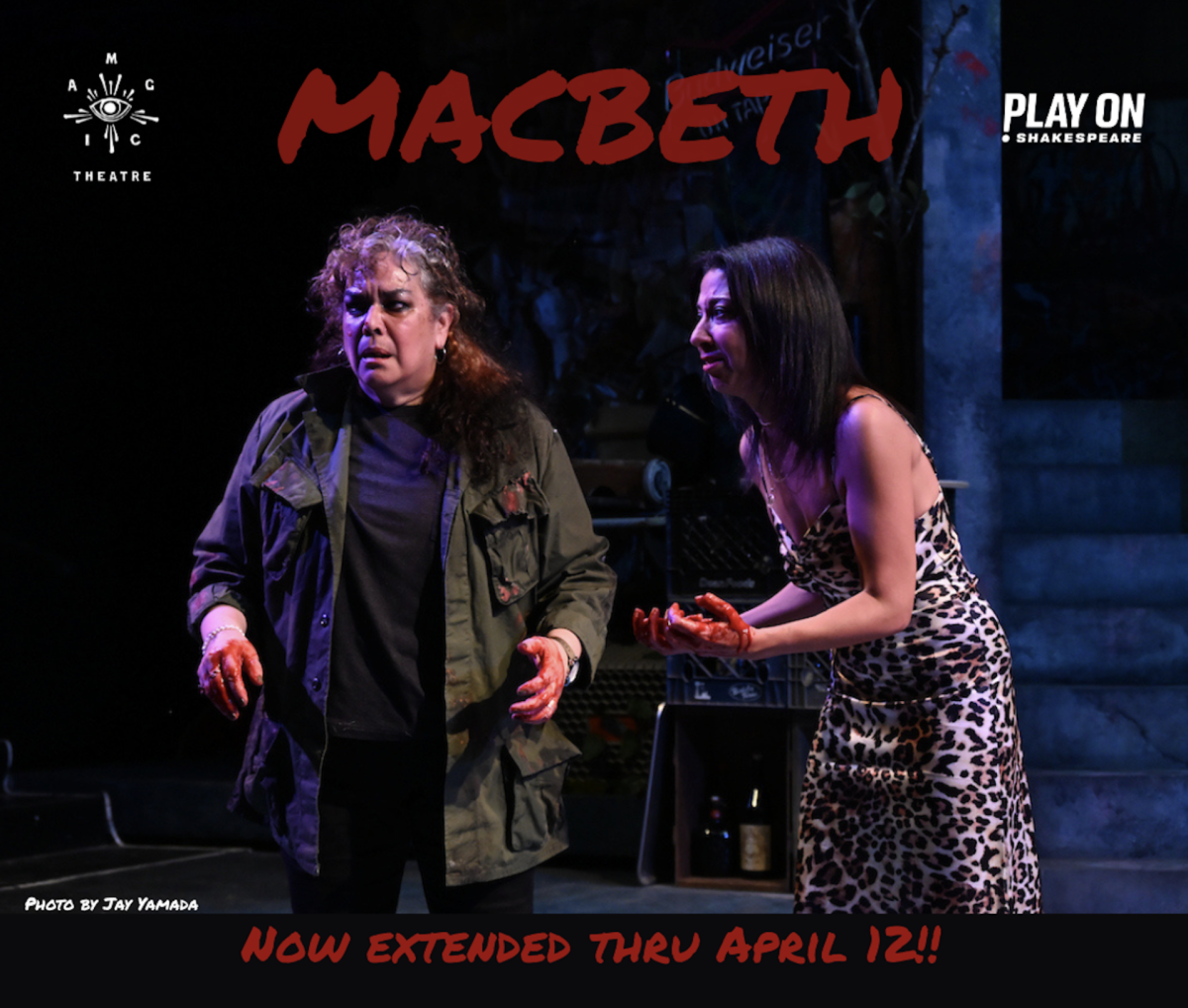
The Sacramento native is currently performing in the world premiere of Macbeth at San Francisco’s Magic Theatre – a stripped-down, 95-minute adaptation set in 1970s New York City. But behind the production’s grit and urgency is something heavier: a theater industry shrinking in real time, and artists struggling to stay afloat.
“A lot of theaters are closing. Funding is getting cut,” Rivera said. “People I’ve looked up to are having to give it up – not because they want to, but because they have to.”
In that context, this Macbeth isn’t just another Shakespeare production. For Rivera and his castmates, it feels like resistance.
Shakespeare, but not the safe version
Directed by Liam Vincent and written by Migdalia Cruz, this adaptation doesn’t ease audiences into familiar territory. It pushes them.
Set against the backdrop of a volatile, crime-ridden 1970s New York, the production trades castles for corruption and reframes power through a modern, multicultural lens. Women lead the story as both Macbeth and Lady Macbeth. Accents are not erased. Identity is not neutralized.
“We’re not worried about sounding ‘proper,’” Rivera said. “People are bringing their full selves - Latin accents, Filipino accents. That matters.”
For Rivera, who plays both King Duncan and Ross, the shift forced a complete reset.
“I had to let go of what I thought Macbeth was,” he said.
That meant diving into unfamiliar territory – studying organized crime, watching The Sopranos, and rethinking how power operates in a world that looks more like today than Shakespeare’s Scotland.
But the bigger challenge wasn’t aesthetic. It was emotional.
Power, insecurity and the cost of survival
Rivera’s King Duncan isn’t a symbol of untouchable authority. He’s a man who knows he’s not the strongest person in the room.
“There’s pride there, but also shame,” Rivera said. “A feeling of, ‘Why couldn’t I be that person?’”
That tension becomes sharper in a production where Macbeth is a woman, a leader Duncan recognizes as capable, even as it exposes his own limitations.
“He sees her worth. He gives her the opportunity,” Rivera said. “But there’s also envy. That’s human.”
As Ross, Rivera occupies the opposite end of power, not the one making decisions, but the one forced to live with them.
“He’s a witness,” Rivera said. “He carries the consequences.”
That includes one of the play’s most devastating responsibilities: delivering news of death.
“He feels guilt,” Rivera said. “He tried to help, but he left. That stays with him.”
It’s a role Rivera is still shaping in rehearsal, tracing the character’s growing anxiety as violence escalates.
“I’m building that suspicion, that worry,” he said. “Because in this world, you feel it coming.”
A story that doesn’t feel like fiction
For Rivera, the most unsettling part of Macbeth is how little distance there is between the play and reality.
“You start with a regime change, then another, and another,” he said. “It never ends.”
He paused, then added:
“That feels very familiar right now.”
Rivera doesn’t shy away from drawing political parallels. He sees the production as speaking directly to a moment marked by division, instability and fear particularly for marginalized communities.
“There are people being erased,” he said. “People who look like us – immigrants, Black and brown communities.”
In that sense, the production becomes more than theater.
“It’s a declaration,” Rivera said. “We still exist. We still have agency.”
The arts crisis isn’t abstract
For student audiences and emerging artists, Rivera’s message is blunt: the struggle isn’t hypothetical. It’s happening now.
“This isn’t something far away,” he said. “It’s right here.”
Across the country, arts funding cuts and institutional instability have already reshaped the landscape. Rivera sees it firsthand in peers leaving the field, in companies scaling back, in opportunities disappearing.
“It’s scary,” he said. “You don’t know what’s going to be left.”
And yet, he also sees something else: artists refusing to disappear quietly.
“We’re sharing spaces. Letting other groups rehearse. Trying to support each other however we can,” Rivera said.
It’s not glamorous. It’s survival.
“A society without art is a society without soul,” he said. “And we’re losing parts of that. But we’re still fighting.”
The long road from Sacramento
Rivera’s path to this moment wasn’t fast or easy.
Raised in Sacramento, he built his foundation locally performing in school productions, studying at Sacramento City College and Sacramento State, and working his way through regional theater.
“I’ve taken the long road,” he said.
He doesn’t describe himself as a natural networker. In fact, he says the opposite.
“I’m not great in social situations,” Rivera said. “I feel fake sometimes.”
Instead, he focused on consistency.
“Just show up. Do the work,” he said. “That’s always been my approach.”
Over time, that approach connected him to major Bay Area companies, including Campo Santo and the San Francisco Mime Troupe, both known for centering multicultural storytelling.
Still, Sacramento remains part of him.
“I used to hate on it,” Rivera admitted. “But now I see how important it was — the people, the artists, the community.”
What’s at stake onstage and off
As opening night approaches, Rivera isn’t thinking about reviews or prestige.
He’s thinking about whether the work lands.
“I want people to walk away feeling something real,” he said. “Like they saw a different angle.”
Because for him, the job isn’t to preserve Shakespeare. It’s to make it matter.
“The only way we connect with an audience is by telling the truth,” Rivera said.
Right now, that truth is uncomfortable.
It’s about power that corrupts. Systems that repeat themselves. Communities that are pushed to the margins and refuse to disappear.
And in a moment when the arts themselves feel under threat, simply putting that truth onstage becomes an act of defiance.
“We’re still here,” Rivera said again.
This time, it doesn’t sound like a line.
It sounds like a warning.